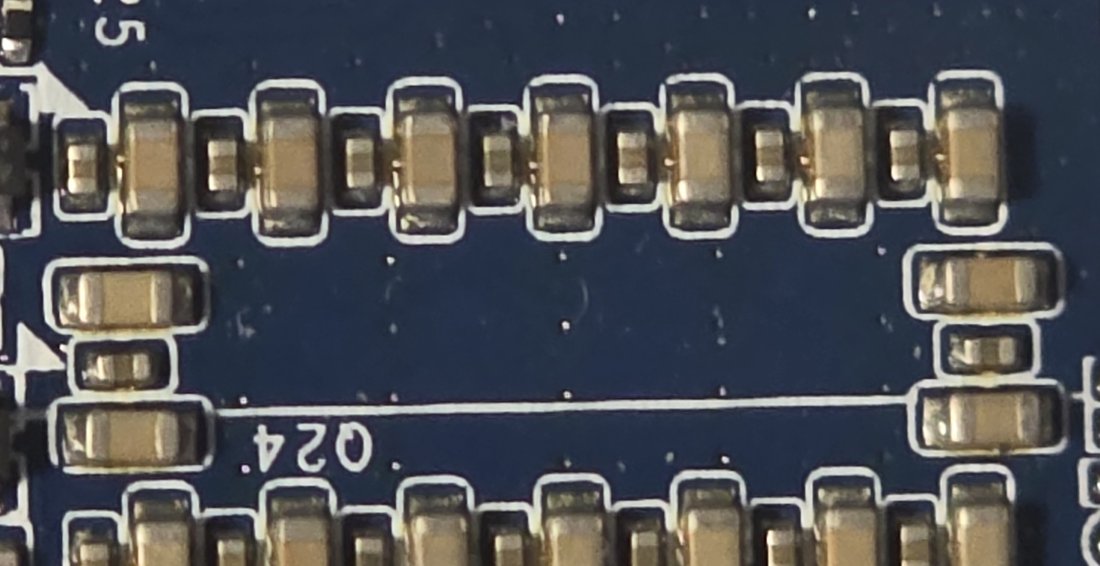
Photo: microscrapping.net
Drawn to true relative scale — the variants above are directly size-comparable.
MLCC — modern nickel (BME, post-2005)
Pale cream, ivory or light tan bodies with bright shiny tin terminations, and small — 0402 and 0201 are modern-only sizes and always base-metal.
How to spot it
Same shape as the valuable ones, from any board made after roughly 2005. Nickel internal electrodes, tin-over-nickel terminations.
Metal content
| Metal | Quantity | Notes |
|---|---|---|
| Palladium | 0.2–0.7 g/lb | measured 0.105 wt% by ICP-OES |
| Silver | 1.4–2.7 g/lb | measured 0.467 wt% |
| Base metal | Ni 5–20%, rare earths ~0.84% |
At 4 Aug 2026 spot prices that works out to $22.6 per lb of contained metal — Palladium 0.45 g = $18.6, Silver 2.1 g = $3.99. A refiner paying $12 per lb returns about 53% of that, which is normal: refining costs money and the buyer takes a margin.
Safe removal
Working temperature: Preheat 240–280 °C
Same as above — preheat plate and scrape. Honestly, on a modern consumer board it's usually not worth the labour; sell the board populated.
Hazards
NEVER dry sweep or use compressed air on a scrapping bench. HEPA-vac or wet-wipe only.
NEVER burn boards, wire insulation or plastic. Ever.
The common trap
Questions
How much gold is in mlcc — modern nickel (bme, post-2005)?
Palladium: 0.2–0.7 g/lb. Silver: 1.4–2.7 g/lb. At current spot that is about $22.6 of contained metal per pound.
How do you identify mlcc — modern nickel (bme, post-2005)?
Pale cream, ivory or light tan bodies with bright shiny tin terminations , and small — 0402 and 0201 are modern-only sizes and always base-metal.
How do you remove mlcc — modern nickel (bme, post-2005) safely?
Same as above — preheat plate and scrape. Honestly, on a modern consumer board it's usually not worth the labour; sell the board populated.
Related in Capacitors
Get this offline → The full guide runs in your browser with no signal, and you can add your own photos.