AI-generated illustration, reviewed against reference photographs. Not a photo of a real part.
Drawn to true relative scale — the variants above are directly size-comparable.
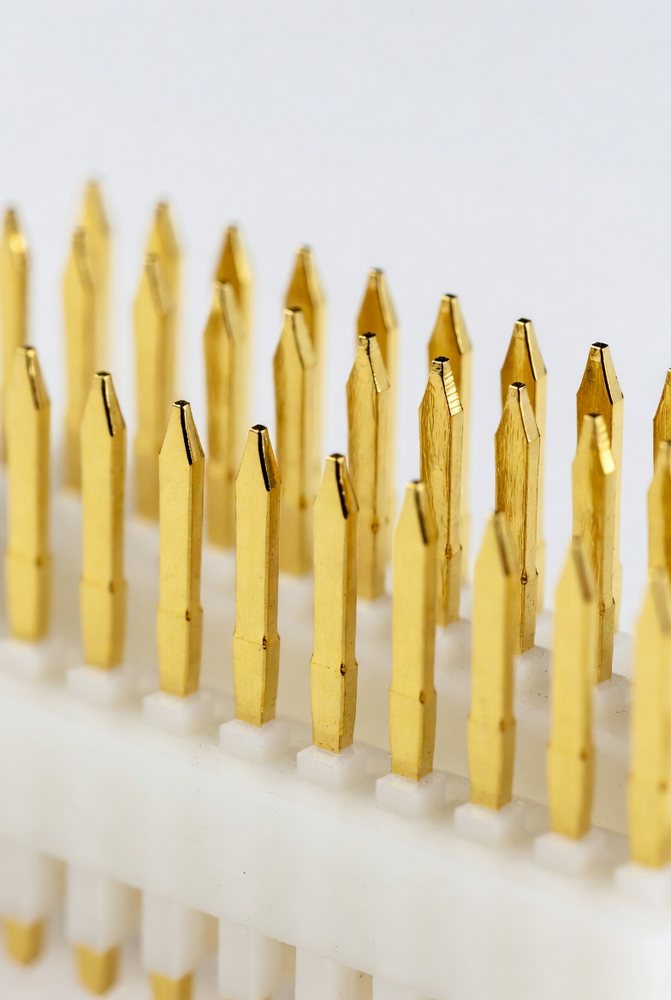
Gold-plated pins
Three checks. (1) Look inside the female sockets with a light — full-depth gold beats tip-only flash. (2) Magnet test — gold over nickel over brass/bronze is non-magnetic and is what refiners want; gold over steel sticks to a magnet and gets discounted or refused. (3) Pale, brassy, greenish or tarnished means brass, not gold.
How to spot it
Round or square pins and sockets from D-sub, IDE/SCSI headers, DIN 41612 backplane connectors, MIL-DTL-38999 circular connectors, IC test sockets.
Metal content
| Metal | Quantity | Notes |
|---|---|---|
| Gold | 0.7–1.5 g/lb mixed | mil-spec round pins 1.5–3.0 g/lb; thin modern headers 0.3–0.7 |
| Base metal | brass, phosphor bronze, BeCu |
At 4 Aug 2026 spot prices that works out to $144 per lb of contained metal — Gold 1.1 g = $144. A refiner paying $5 per lb returns about 3% of that, which is normal: refining costs money and the buyer takes a margin.
Safe removal
Working temperature: Hot plate 250–290 °C / heat gun 400–500 °C
Preheat the connector body on a hot plate or griddle at 250–290 °C (or heat gun 400–500 °C, kept moving) until the plastic softens and solder flows, then pull pins with pliers or rap the connector face-down on a bin edge. For through-hole headers, preheat the board from underneath to 230–260 °C and pull the whole header first.
Hazards
NEVER put BeCu in a grinder, a sandblaster, or a melt.
NEVER dry sweep or use compressed air on a scrapping bench. HEPA-vac or wet-wipe only.
The common trap
Questions
How much gold is in gold-plated pins?
Gold: 0.7–1.5 g/lb mixed. At current spot that is about $144 of contained metal per pound.
How do you identify gold-plated pins?
Three checks. (1) Look inside the female sockets with a light — full-depth gold beats tip-only flash. (2) Magnet test — gold over nickel over brass/bronze is non-magnetic and is what refiners want; gold over steel sticks to a magnet and gets discounted or refused. (3) Pale, brassy, greenish or tarnished means brass, not gold.
How do you remove gold-plated pins safely?
Preheat the connector body on a hot plate or griddle at 250–290 °C (or heat gun 400–500 °C, kept moving) until the plastic softens and solder flows, then pull pins with pliers or rap the connector face-down on a bin edge. For through-hole headers, preheat the board from underneath to 230–260 °C and pull the whole header first.
Related in Connectors & pins
Get this offline → The full guide runs in your browser with no signal, and you can add your own photos.