Photo: microscrapping.net
Drawn to true relative scale — the variants above are directly size-comparable.
Desktop motherboards
Grade tracks the socket era. Large socket boards $7.75/lb, small P4 $4.40, metal-socket $3.65, i-series/AM4 only $2.10. Newer is leaner — modern boards have less gold and fewer through-holes.
How to spot it
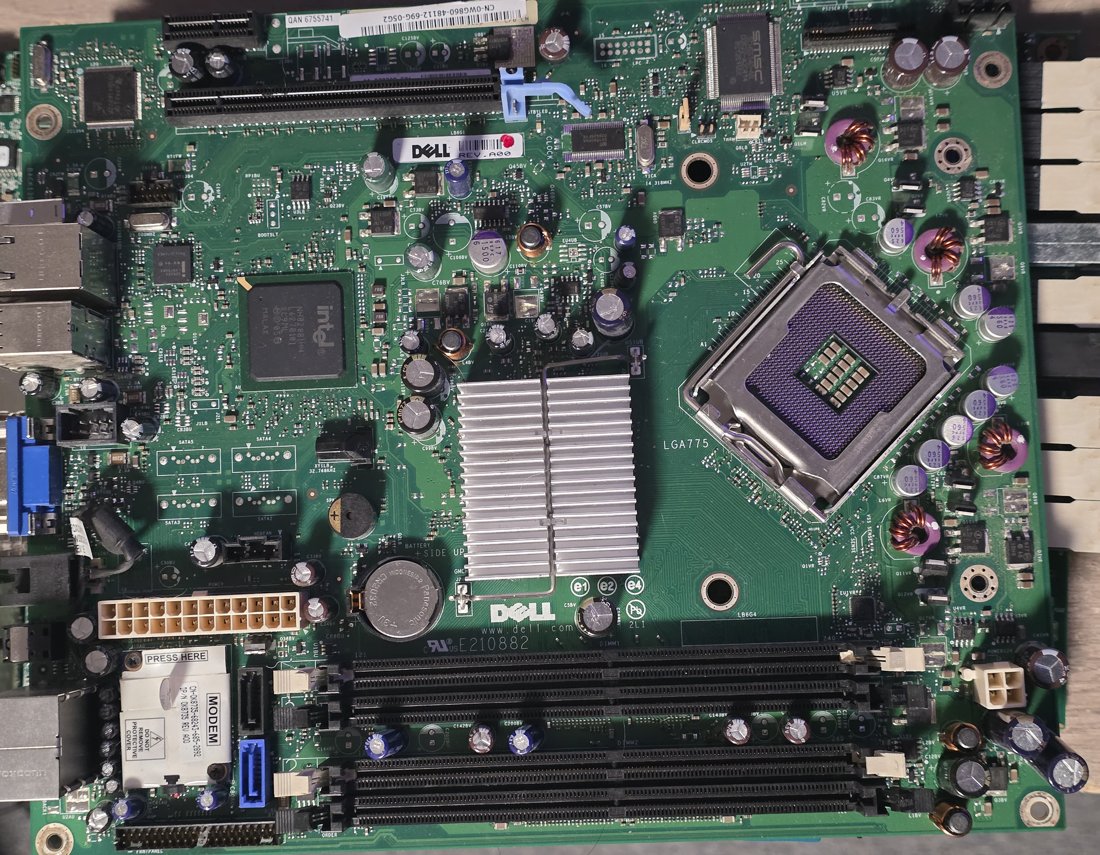
Coloured soldermask, one CPU socket, several expansion slots with gold fingers, moderate IC count, a mix of SMD and through-hole, 4–8 layers.
Metal content
| Metal | Quantity | Notes |
|---|---|---|
| Gold | 0.02–0.15 g/lb | era-dependent: modern boards assay near 50 g/tonne, 1990s boards 3–6× that. The old "8–11 troy oz per short ton" rule describes vintage boards, not current ones |
| Silver | 0.6–2 g/lb | |
| Palladium | 0.01–0.05 g/lb | |
| Copper | 15–20% |
At 4 Aug 2026 spot prices that works out to $7.96 per lb of contained metal — Gold 0.035 g = $4.57, Silver 0.9 g = $1.71, Copper 80 g = $0.86, Palladium 0.02 g = $0.83. A refiner paying $5 per lb returns about 63% of that, which is normal: refining costs money and the buyer takes a margin.
Safe removal
Pull CPU, RAM, gold-fingered cards and the socket. Then sell as mid-grade board.
Hazards
NEVER dry sweep or use compressed air on a scrapping bench. HEPA-vac or wet-wipe only.
A standard ABC extinguisher will NOT stop a runaway lithium cell. Don't count on one.
The common trap
Questions
How much gold is in desktop motherboards?
Gold: 0.02–0.15 g/lb. Silver: 0.6–2 g/lb. Palladium: 0.01–0.05 g/lb. Copper: 15–20%. At current spot that is about $7.96 of contained metal per pound.
How do you identify desktop motherboards?
Grade tracks the socket era. Large socket boards $7.75/lb, small P4 $4.40, metal-socket $3.65, i-series/AM4 only $2.10. Newer is leaner — modern boards have less gold and fewer through-holes.
How do you remove desktop motherboards safely?
Pull CPU, RAM, gold-fingered cards and the socket. Then sell as mid-grade board.
Related in Boards
Get this offline → The full guide runs in your browser with no signal, and you can add your own photos.